Bookshelf depth and load: what a shelf holds
A shelf collapses for one reason: the span is too long for the board and the load. Everything else, the finish, the colour, the shape, is decoration on top of that sum.
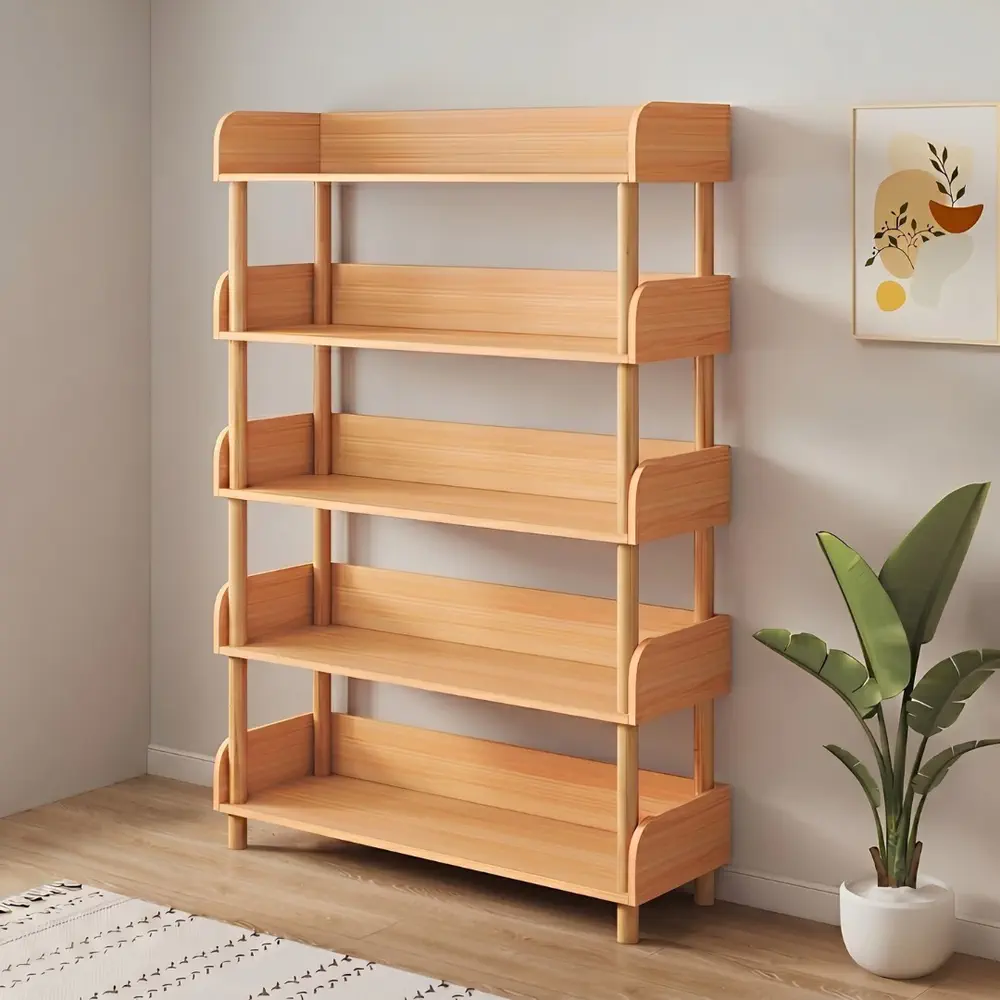
Our workshop cuts shelves from 18mm and 25mm boards and loads them with sandbags before a design is approved. The figures below come from those tests and from what customers report after two or three monsoons.
Span decides sag
An 18mm board will sag visibly past about 800mm of unsupported span under a full load. At 600mm it stays flat for years. At 1,000mm you can see a curve within months, and a curved shelf holds less because the books lean inward towards the middle.
The fix is cheap at the drawing stage: add a 25mm upright, move to a 25mm shelf, or fit a 40mm stiffener under the front edge. Retrofitting a support afterwards means emptying the shelf, drilling into a finished surface and working around the books. A centre divider at 900mm costs less than replacing a bowed shelf twice.
What a metre of books weighs
Paperbacks average 300g each and run 20 to 25 per metre. Hardbacks weigh 700g to 1kg and sit 12 to 15 per metre. A shelf packed with hardbacks therefore carries 12kg to 15kg per metre, and a deep shelf can hold two rows. Two rows of paperbacks double the figure, so check the depth before filling it.
Plan for 30kg per metre and you keep margin for bookends, a plant and the stack someone always leaves flat on top. The back panel helps here, so specify 12mm rather than 3mm hardboard. It adds stiffness as well as dust protection, and it stops a row of books pushing through when the shelf is full.
Depth: 280mm or 350mm
A standard hardback is 240mm tall and 160mm deep; an art book reaches 300mm. A 280mm shelf takes nearly everything upright with 20mm to spare at the front. A 350mm shelf lets you double-stack paperbacks, but the back row disappears and is rarely touched again.
Height matters just as much. Fixed shelves at 320mm pitch suit most fiction. Adjustable shelves on a 32mm pin system let you set one bay at 380mm for albums and keep the rest tight, which recovers roughly one extra shelf in a 1,800mm tall unit. A 300mm deep shelf is a reasonable middle ground for a small room. Short spans still matter more than depth.
Fixing it to the wall
A loaded 1,800mm tall bookshelf can weigh 120kg to 180kg. Dhaka walls are often hollow block, so an anti-tip bracket must go into a solid fixing rather than the block face. Two brackets at the top, each rated for 40kg, take ten minutes to fit.
Before ordering, count your books shelf by shelf and note the longest span you need. Send those figures to 01337-339693 and we will confirm a board thickness. Made-to-order units take 7 to 14 working days, and the span decides the price more than the finish does.
Frequently asked questions
How much weight can a bookshelf shelf hold?
Plan for 30kg per metre on an 18mm shelf with supports at both ends and a span under 800mm. Paperbacks weigh about 300g each and hardbacks 700g to 1kg, so a metre of hardbacks is 12kg to 15kg before bookends.
Why is my shelf bowing in the middle?
The span is too long for the load. Past 800mm an 18mm board creeps under sustained weight, and Dhaka humidity speeds that up. Add a centre upright, move to 25mm board, or fit a stiffener under the front edge.
Do I need to anchor a bookshelf to the wall?
A loaded 1.8m unit can weigh 120kg to 180kg, and a hollow block wall will not hold a bracket by friction. Use two top brackets into a solid fixing. This matters most in rented flats with children or a low bed nearby.
Where to go next
Current prices for this range are on the Bookshelf price list. If you want to compare two sizes side by side, start with Modern 5-Tier Bookshelf – Wood and Modern Bookshelf – White & Gold Steel. Send the wall measurement on WhatsApp and we will confirm what fits before you order.