Gorjon, mahogany or teak: choosing a sofa frame
A sofa frame stays invisible until it fails. By then the fabric is fine, the foam is fine, and the whole piece creaks whenever somebody leans on an arm or shifts in the corner seat.
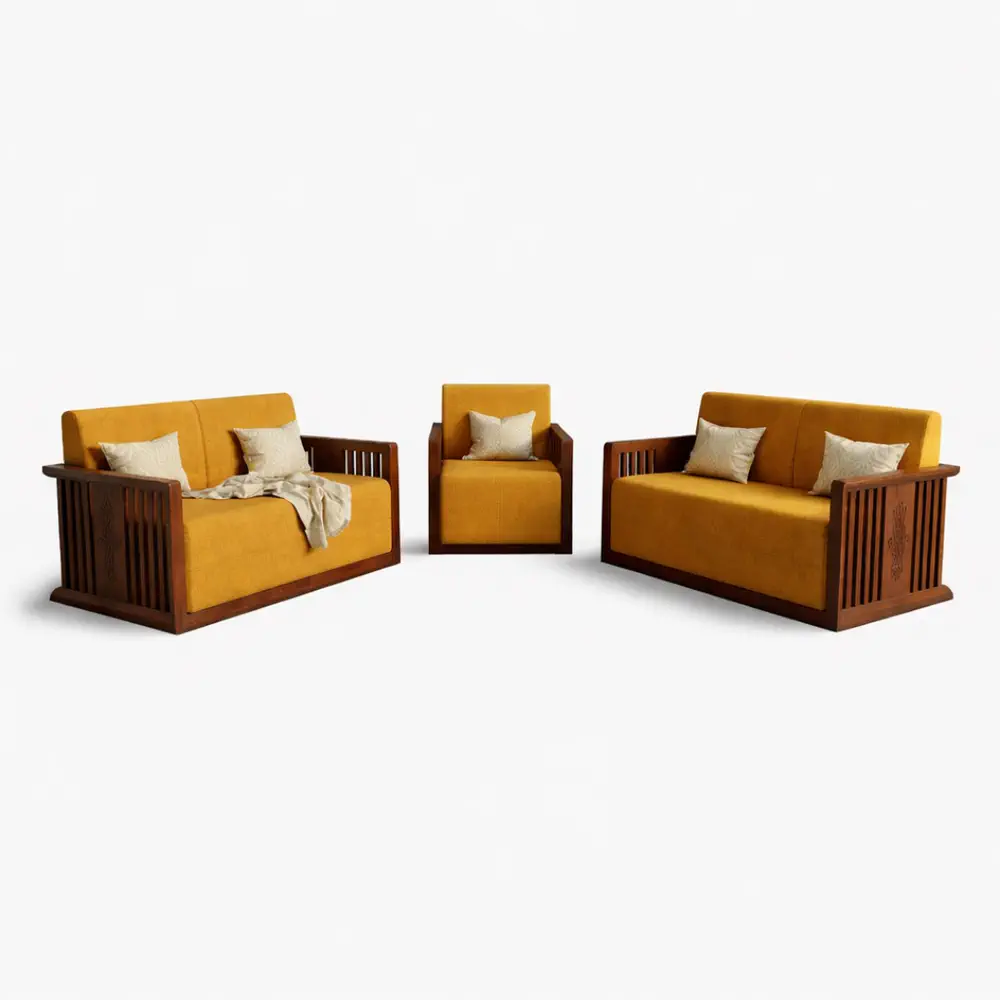
We build frames from three timbers: seasoned gorjon, mahogany and teak. Each behaves differently in Dhaka air, and the difference shows up in weight, in joinery and in what the piece costs to make. This is what we check on the bench.
What the frame actually carries
Every sofa load passes through four points: the two front legs, the rear rail and the joint where the arm meets the seat. Kiln-dried timber at 8 to 12 percent moisture content holds those joints tight through a monsoon, where green wood simply does not.
Green or air-dried wood often starts above 20 percent. As it dries in a flat, the rail shrinks across the grain, the screw holes open, and the frame works itself loose within two seasons. You feel it as a click under the seat.
Gorjon: the local workhorse
Gorjon, the tough hardwood sold across Dhaka sawmills, takes a screw well and resists splitting along the rail. At 8 to 12 percent moisture it is stable enough for a 2.4 metre frame with a centre support leg and a braced corner.
It is the timber we use most, and it keeps a five-seater frame near 45 kg, light enough for two people to shift. Under a ten-year frame warranty, gorjon handles ordinary family use without complaint.
Mahogany: straighter, quieter
Mahogany planes to a cleaner edge and holds a dowel joint with less movement than gorjon. Frames built from it weigh a little more and stay silent for longer, because the grain runs straighter along the arm and the rail.
The cost sits between the other two. If a sofa will move between flats every few years, mahogany tolerates the knocks better and shows fewer splits at the leg blocks, where lifting damage appears first.
Teak: heavy, oily, long-lived
Teak carries its own oil, which slows moisture uptake. That is why a teak frame survives a damp ground-floor flat better than either alternative, and why a teak three-seater can weigh 60 kg. Thicker sections account for part of that weight; the density accounts for the rest.
It also costs the most and blunts tools quickly, so teak frames are usually reserved for pieces meant to stay in one room for twenty years. Check that the visible frame and the hidden rails are the same species.
What to inspect before you order
Turn the sofa over, if the shop allows, and look at the corner blocks. A solid block glued and screwed across the joint does more for rigidity than bracing nailed along the rail, and it adds very little to the cost of a frame.
Ask what the timber is, how it was dried and what the frame warranty covers. Note the answers on your order. If you are comparing two pieces, bring a tape and measure rail thickness: 25 mm is thin, 40 mm is serious.
Frequently asked questions
Does the frame timber change the price much?
It does, and mostly through material cost rather than labour. Teak sits at the top, mahogany in the middle, gorjon at the base. A larger frame uses more timber, so the gap widens on five-seaters and L-shapes compared with a two-seater.
Is teak worth it in a humid flat?
For a ground-floor flat with poor ventilation, often yes. Teak takes up moisture slowly and moves less across the monsoon. On an upper floor with cross ventilation, seasoned gorjon at 8 to 12 percent moisture performs well for a decade at much lower cost.
How can I tell seasoned wood from green wood?
Look at the end grain and the weight. Seasoned timber feels dry, rings slightly when tapped and shows small, tight drying checks. Green wood feels cold and heavy, and its checks are wide. Ask for the moisture reading, which a workshop can take in seconds.
Where to go next
Current prices for this range are on the Sofa price list. If you want to compare two sizes side by side, start with the category page. Send the wall measurement on WhatsApp and we will confirm what fits before you order.